
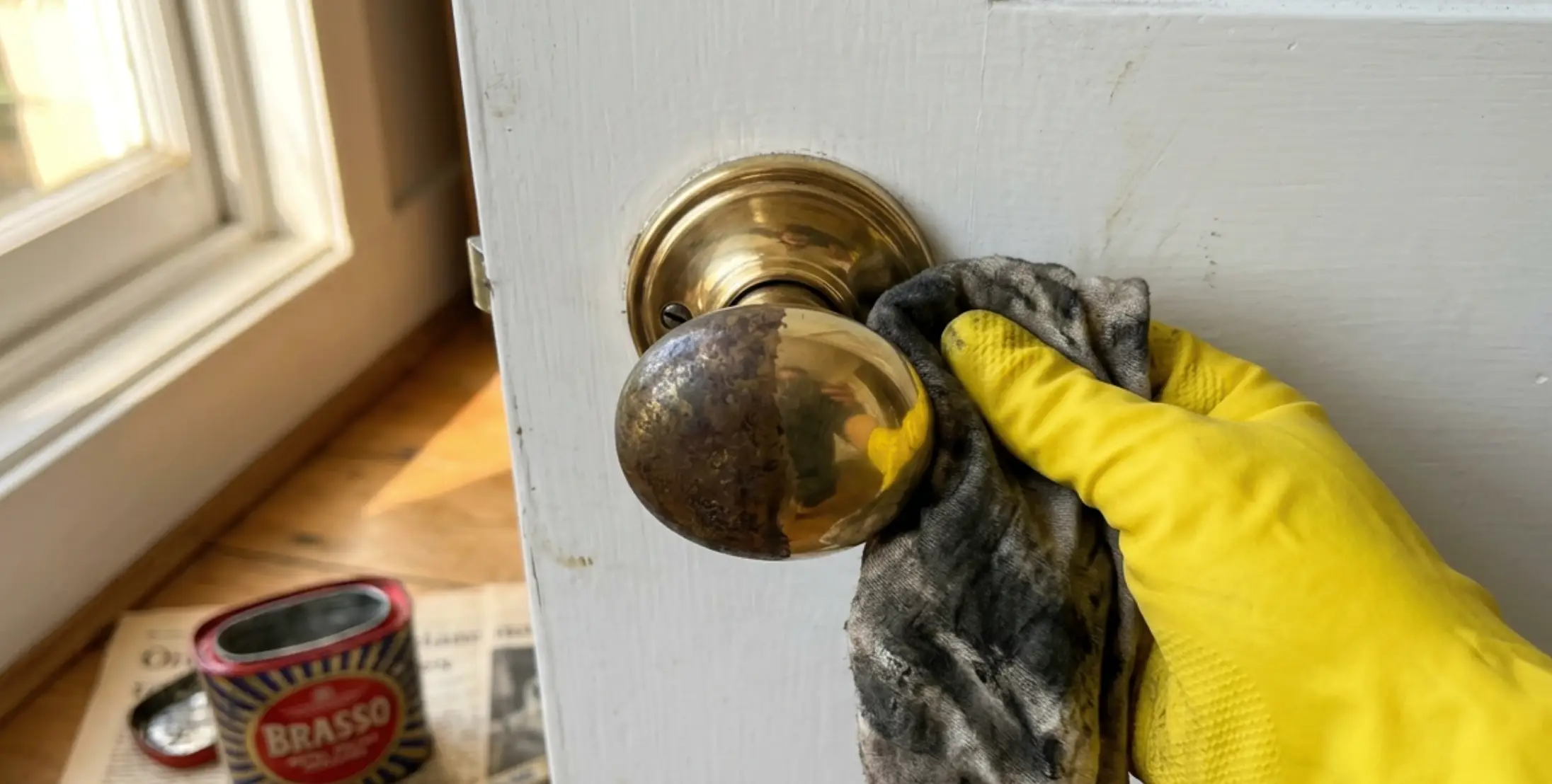
What tarnish actually is (and why it's not the same as dirt)
Brass is an alloy of copper and zinc. When it's exposed to air, the copper in the alloy reacts with oxygen and moisture to form copper oxide — a dull, dark layer on the surface that we call tarnish. It's a chemical reaction, not dirt. You can't wipe it off with a damp cloth any more than you can wipe rust off steel.
The speed at which brass tarnishes depends on its environment. Humidity accelerates it — which is why brass in bathrooms and kitchens tarnishes faster than brass in a dry hallway. Skin oils from handling also speed things up, so door handles, cabinet pulls, and light switches are usually the first things to go dull.
If tarnish is left long enough, it progresses from a dull brown to a dark greenish layer called verdigris — the same patina you see on old copper roofs and statues. Verdigris looks dramatic but it's still just surface oxidation. In almost every case, no matter how dark or green the brass looks, the metal underneath is perfectly fine and can be restored to a bright shine.
The key thing to understand is that tarnish removal requires an acid — something that chemically dissolves the copper oxide layer. That's why the most effective brass cleaning methods all involve acidic ingredients: vinegar, lemon juice, ketchup (which contains vinegar and tomato acid), or purpose-made brass cleaners.
Lacquered vs unlacquered brass — how to tell (and why it matters)
This is the single most important thing to check before you start cleaning. Get it wrong and you'll make the problem worse.
Lacquered brass has a thin, clear protective coating applied at the factory. This coating prevents air from reaching the metal, so lacquered brass doesn't tarnish — at least not until the lacquer wears through or gets scratched. When that happens, tarnish appears in patches where the coating has broken down, while the rest of the surface stays shiny. That patchy, uneven look is a dead giveaway that you're dealing with lacquered brass.
If your brass has lacquer, you have two choices. You can strip the remaining lacquer off entirely (using acetone or nail polish remover) and then clean and polish the raw brass underneath. Or you can live with it and avoid polishing — because rubbing polish on lacquered brass just damages more of the coating and makes the patchiness worse.
Unlacquered brass is raw metal with no coating. It tarnishes evenly over time and responds brilliantly to all the cleaning methods below. Most antique brass, solid brass hardware, and high-end door furniture is unlacquered.
The test is simple: pick a small, hidden area — the back of a handle, the underside of a hinge — and rub it with a dab of Brasso or brass polish on a soft cloth. If the cloth picks up dark residue and the brass underneath starts to brighten, it's unlacquered and you can proceed. If the cloth stays clean and nothing happens, there's lacquer in the way.
Hold a magnet against it. Brass is not magnetic. If the magnet sticks, it's brass-plated steel, and polishing will eventually wear through the plating to the grey steel underneath. Brass-plated items can't be restored the same way — once the plating is worn, the only fix is replating or replacement.
Vinegar and salt method
This is the most effective household method for heavily tarnished brass. The acetic acid in vinegar dissolves the copper oxide, and the salt acts as a mild abrasive that helps lift the tarnish mechanically as you rub.
Mix one teaspoon of salt into half a cup of white vinegar and stir until dissolved. Add enough plain flour to make a thick paste — roughly two tablespoons. The flour is just a thickener; it keeps the mixture on the brass surface instead of running off.
Spread the paste over the tarnished brass with your fingers or a soft cloth. Leave it for 15–30 minutes. For really heavy tarnish — the dark brown or greenish kind — leave it for up to an hour. The longer it sits, the more oxidation the acid dissolves.
Rub the paste off with a soft cloth using circular motions. You'll see the cloth turning dark brown or green — that's the tarnish coming away. Rinse the brass with warm water, dry it completely with a clean cloth, and check the result. One round is usually enough for moderate tarnish. Heavy tarnish may need a second application.
Why this works better than vinegar alone: the salt provides just enough grit to break through thick oxidation without scratching the brass. And the flour paste keeps the acid in contact with the surface for longer, which is crucial for heavy tarnish.
Lemon and baking soda method
Lemon juice is citric acid — effective against tarnish and much more pleasant to work with than vinegar. Combined with baking soda, which provides gentle abrasion and fizzes satisfyingly when mixed with acid, it makes a good paste for moderate tarnish.
Squeeze the juice of one lemon and mix in baking soda a teaspoon at a time until you get a spreadable paste. It will fizz — that's the acid reacting with the sodium bicarbonate. Let it settle for a moment, then apply to the brass.
Leave for 10–15 minutes, rub with a soft cloth, rinse, and dry. This method smells better than vinegar and works well for light to moderate tarnish. For really stubborn oxidation, the vinegar-salt-flour paste above is stronger.
One thing to know: the fizzing reaction between lemon juice and baking soda actually neutralises some of the acid. So the paste is less acidic than straight lemon juice. If you want maximum cleaning power, use lemon juice alone — rub half a lemon directly over the brass surface, leave for 10 minutes, then scrub. The baking soda version is gentler, which makes it better for delicate or thin brass.
The ketchup trick (yes, really)
This sounds like a joke but it genuinely works. Ketchup contains vinegar, tomato acid (citric and malic acid), and a small amount of salt — basically a mild brass cleaning paste that comes ready-mixed in a bottle.
Squeeze a generous layer of ketchup over the tarnished brass. Leave it for 15–30 minutes. Rub with a soft cloth, rinse with warm water, and dry. The result won't match a dedicated brass polish, but for a quick fix using something you already have in the fridge, it's surprisingly effective.
The main downside is that ketchup also contains sugar, which can leave a sticky residue if you don't rinse thoroughly. It's also not strong enough for heavy, years-old tarnish — think of it as a maintenance method for light tarnish, not a rescue method for neglected brass.
Commercial brass cleaners — Brasso and beyond
For heavily tarnished brass, a purpose-made brass cleaner is the fastest and most reliable option. The most widely available in the UK is Brasso — it's been around since 1905 and it works. Other good options include Bar Keepers Friend (powder form), Autosol metal polish, and Peek paste.
Brasso is a chemical polish that contains a blend of solvents, mild acids, and very fine abrasive particles suspended in a liquid. You apply it with a soft cloth, rub in circular motions, and the combination of chemical dissolution and mechanical polishing removes tarnish quickly and evenly. The cloth turns black as you work — that's normal.
For brass that's been neglected for years, Brasso will usually restore it in one or two applications where household methods might need three or four rounds. It also leaves a thin protective film that slows retarnishing.
The trade-off is the smell — Brasso has a strong chemical odour, so work in a ventilated area. And it's not something you want to use on large surfaces in an enclosed room. For a single set of door handles, it's fine. For every fitting in a house, open the windows.
Bar Keepers Friend deserves a mention because it works differently — it's an oxalic acid powder that you mix with water to form a paste. It's excellent for heavy tarnish and also works on copper, stainless steel, and ceramic. It's more abrasive than Brasso, so use a light touch on thin or delicate brass.
Brasso's abrasive particles will strip the lacquer coating, creating patchy, uneven results that look worse than the original tarnish. If your brass is lacquered, either strip all the lacquer first (acetone), or leave it alone.
Step-by-step: restoring heavily tarnished brass
- Check if it's lacquered. Test a hidden spot with a dab of polish. If the cloth darkens and the brass brightens, it's unlacquered — proceed. If nothing happens, strip the lacquer with acetone first, or decide to leave it.
- Remove the hardware if possible. Unscrew door handles, hinges, or fittings and work on them off the door. You'll get a much better result than trying to polish in place, and you avoid getting cleaning products on the surrounding woodwork or paint.
- Wash off surface grime. Soak the brass in warm water with a squirt of washing-up liquid for 10 minutes. This removes grease, dust, and loose debris so the cleaning solution can work directly on the tarnish. Dry thoroughly.
- Apply your chosen cleaning method. For heavy tarnish, use the vinegar-salt-flour paste or Brasso. Apply generously and leave for 15–30 minutes (household paste) or apply and rub immediately (Brasso). Work in small circular motions.
- Scrub stubborn spots. For tarnish that won't budge — crevices in ornate handles, screw holes, hinge knuckles — use an old toothbrush dipped in your cleaning solution. The bristles reach into grooves that a cloth can't.
- Rinse and dry completely. Rinse with clean warm water to remove all residue. Dry immediately and thoroughly — any moisture left on the surface starts the tarnishing process again immediately. Use a clean, dry microfibre cloth.
- Buff and protect. Once dry, buff with a clean soft cloth until the brass shines. For long-term protection, apply a thin coat of Renaissance Wax, clear paste wax, or even a light film of mineral oil. This creates a barrier between the brass and the air, significantly slowing retarnishing.
Mistakes that damage brass (avoid these)
Brass is a relatively soft metal. It scratches easily, and scratches on brass are permanent — they can't be polished out without removing a visible layer of material. Most brass cleaning disasters come from using the wrong tools.
**Steel wool, wire brushes, and Brillo pads** — these will leave deep, visible scratches in seconds. Brass is softer than steel, so any steel abrasive will gouge the surface. Only use soft cloths, microfibre, or at most a soft-bristle toothbrush.
**Leaving cleaning solution on too long** — acidic solutions (vinegar, lemon, commercial cleaners) dissolve copper oxide effectively. But left on for hours, they'll start etching the brass itself. Stick to the recommended times: 15–30 minutes for household pastes, follow the label for commercial products.
**Not rinsing properly** — dried vinegar, salt, or cleaner residue will cause new tarnish (and sometimes pitting) faster than if you'd done nothing. Always rinse thoroughly with clean water and dry completely.
**Polishing lacquered brass** — covered above, but worth repeating. Rubbing polish on lacquered brass strips the coating unevenly, creating a patchy mess. Test first, always.
**Cleaning brass-plated items as if they're solid brass** — aggressive polishing wears through thin plating to the base metal underneath. If the magnet test tells you it's plated, go very gently or skip polishing entirely.
How to keep brass from tarnishing again
Once you've done the hard work of restoring tarnished brass, a few habits will keep it looking good for much longer between deep cleans.
**Apply a protective coating after cleaning.** Renaissance Wax is the gold standard — museums use it on brass artefacts. A thin coat after polishing creates an invisible barrier that dramatically slows oxidation. It lasts several months before needing reapplication. If you can't get Renaissance Wax, clear paste wax (Liberon or similar) works almost as well. In a pinch, a very thin film of mineral oil or even car wax provides some protection.
**Dust regularly.** Dust particles trap moisture against the brass surface, accelerating tarnish. A quick wipe with a dry microfibre cloth once a week makes a noticeable difference.
**Handle less where possible.** Skin oils are one of the biggest tarnish accelerators. This is unavoidable for door handles, but for decorative brass — candlesticks, ornaments, picture frames — wearing cotton gloves when you clean or reposition them genuinely helps.
**Control humidity.** If brass fixtures are in a bathroom or kitchen, adequate ventilation slows tarnishing. Extractor fans running during and after cooking or showering make a real difference — not just for brass, but for limescale on taps and fittings too.
**Quick polish every few months.** A 30-second rub with Brasso or a vinegar-dampened cloth every 2–3 months stops tarnish from building up to the point where it needs a full restoration session. Maintenance polishing is always easier than rescue polishing.
When polishing isn't enough
Most tarnished brass can be restored regardless of how bad it looks. But there are a few situations where cleaning won't give you the result you want.
If the brass is deeply pitted — small craters in the surface from prolonged corrosion or exposure to salt air — polishing will brighten it but the pitting remains. The surface will never be smooth again. At that point, you're deciding between living with the texture (which some people like as a character feature) or replacing the hardware.
If it's brass-plated and the plating has worn through, polishing exposes more of the base metal and makes the problem worse. Replating is possible but expensive — usually more than the cost of replacement hardware unless the items are antique or sentimental.
If the brass is part of a fixture that's mechanically worn out — a loose door handle, a hinge with stripped screws, a lock mechanism that no longer works — it's usually more practical to replace the whole fitting with new brass hardware than to polish something that doesn't function properly.
For rental properties specifically, brass door furniture in poor condition is something checkout inspectors notice. If you're approaching an end of tenancy clean and the brass fittings are heavily tarnished, it's worth either restoring them yourself using the methods above or flagging it to your cleaning company. Our end of tenancy cleaning includes polishing all accessible metal fixtures as part of the standard scope.
Related services
End of Tenancy Cleaning
Our EOT clean includes polishing all accessible metal fixtures — brass handles, hinges, letterboxes, and chrome fittings.
View serviceDeep Cleaning
Professional deep cleans across London — we handle every surface, fitting, and fixture room by room.
View serviceOur Guarantee
48-hour re-clean guarantee on every end of tenancy clean. If the agent flags issues, we come back free of charge.
View serviceFrequently asked questions
A quick wipe with a dry cloth weekly, and a proper polish with Brasso or a vinegar solution every 2–3 months. In humid environments (bathrooms, kitchens), you may need to polish monthly.
Yes — white vinegar is one of the most effective household brass cleaners. Mix it with salt and flour for a paste, or use it on its own for a quick wipe. Always rinse thoroughly and dry immediately afterwards.
Almost never. Tarnish is surface oxidation that sits on top of the brass — the metal underneath is fine. Even brass that's turned completely dark brown or green can usually be restored to a bright shine with the right method and some patience.
Brasso or Bar Keepers Friend, applied with a soft cloth and rubbed in circular motions. Commercial cleaners work significantly faster than household alternatives on heavy tarnish — usually one application versus several rounds with vinegar or lemon.
Not if used correctly on unlacquered brass. It's been the standard brass polish in the UK for over a century. The only risk is using it on lacquered brass (strips the coating) or brass-plated items (can wear through thin plating with repeated use).
Hold a magnet to it. Solid brass is not magnetic. If the magnet sticks, the item has a steel core with brass plating on top. You can also check the edges or wear points — if you see a different-coloured metal showing through, it's plated.
WD-40 can remove light tarnish and leaves a protective oily film that slows retarnishing. It's a decent quick fix for lightly tarnished brass but won't cut through heavy oxidation the way vinegar, Brasso, or Bar Keepers Friend will.
Mask off the surrounding woodwork or paint with painter's tape. Apply your chosen cleaner with a soft cloth, working carefully around the edges. Use a toothbrush for crevices. Wipe clean with a damp cloth rather than rinsing to avoid water running onto the door surface.