
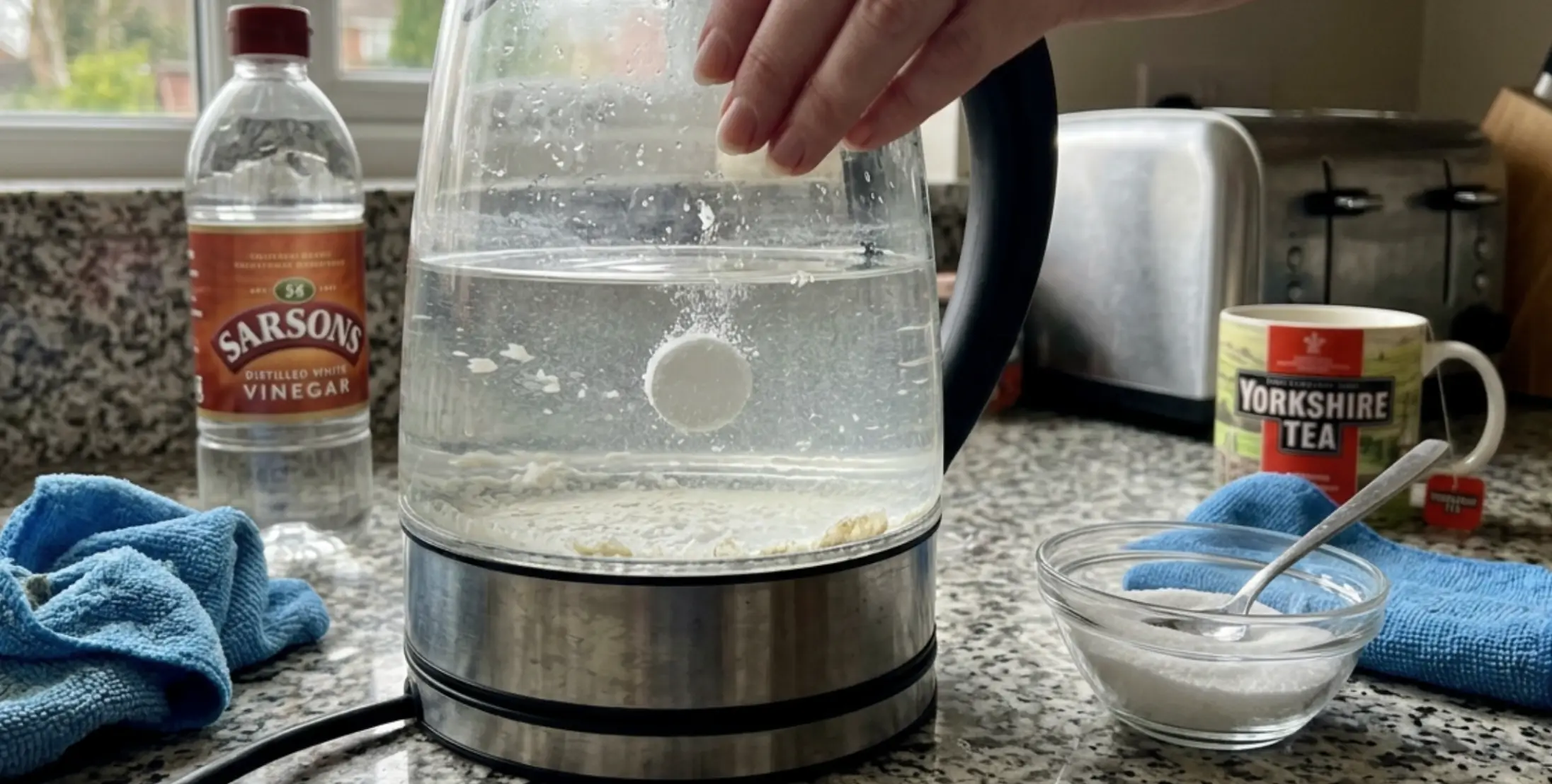
Why limescale builds up in glass kettles (and why it matters)
Every time you boil water in a kettle, dissolved minerals — primarily calcium carbonate and magnesium — are left behind as the water evaporates or is poured off. These minerals accumulate on the heating element, the base plate, and the internal walls of the kettle as a chalky white or off-white crust known as limescale.
In a stainless steel kettle, you might not notice it for weeks. In a glass kettle, it’s visible almost immediately — cloudy patches on the glass, a rough white coating on the metal base plate, and flakes floating in the water when you boil.
Limescale isn’t a health hazard. Calcium carbonate is the same mineral found in antacid tablets, and drinking water that contains it won’t harm you. But there are three practical reasons to deal with it regularly.
It wastes energy. Limescale acts as an insulator. When it coats the heating element, the kettle has to work harder and run longer to bring water to a boil. A heavily scaled kettle can use up to 25% more energy than a clean one — that adds up over months of daily use.
It affects your drinks. Loose flakes of limescale break off during boiling and end up in your cup. They’re harmless but unpleasant — white bits floating in your tea or settling at the bottom of your coffee. This is the complaint that drives most people to descale.
It shortens the kettle’s life. Persistent limescale buildup degrades the heating element faster. It heats unevenly, cycles more frequently, and in severe cases the element can burn out entirely or the base plate can warp. A clean kettle lasts years longer than a neglected one.
London’s hard water problem
If you live in London, limescale is an unavoidable fact of life. The capital sits on a chalk and limestone aquifer, and Thames Water’s supply is classified as “very hard” — typically between 200 and 350 parts per million (ppm) of calcium carbonate, depending on your postcode. For context, water above 200 ppm is considered hard; much of London sits well above that threshold.
This means a kettle used daily in London will develop visible limescale in as little as one to two weeks. In softer water regions — parts of Scotland, Wales, or the North West — the same kettle might go months without showing any buildup at all.
It’s the same mineral deposit that affects shower screens, taps, and bathroom tiles — which is why limescale removal is a significant part of any deep cleaning or end of tenancy cleaning job we carry out across London. The principles are identical whether you’re descaling a kettle or restoring chrome fixtures in a bathroom: you need an acid-based solution to dissolve the calcium carbonate.
Descaling tablets: pros, cons, and how to use them
Descaling tablets are the most convenient option for regular kettle maintenance. They’re pre-measured, dissolve cleanly in water, and are formulated specifically for kitchen appliances — meaning they’re safe for the heating element, the glass body, the rubber seals, and the plastic lid components found in most modern glass kettles.
Most descaling tablets are based on citric acid, sulphamic acid, or a blend of the two. They work by reacting with calcium carbonate to dissolve it into solution, which you then pour away and rinse out. The process is almost entirely hands-off.
The main advantage over household alternatives (vinegar, lemon juice) is consistency. A tablet is a known quantity — same concentration, same reaction time, same result every time. Vinegar strength varies by brand, and lemon juice varies by lemon. With tablets, you don’t need to measure or guess.
The trade-off is cost. A box of six descaling tablets typically costs £3–6, while a bottle of white vinegar (which will last for dozens of descales) costs under £1. For light, regular maintenance, tablets are ideal. For heavy buildup that’s been left for months, you may need a stronger approach — or multiple rounds.
Step-by-step: descaling with tablets
- Empty and rinse the kettle. Pour out any remaining water and give the interior a quick rinse. You want to start clean so the tablet’s active ingredients aren’t wasted reacting with loose debris or old water.
- Drop in one tablet. One tablet is sufficient for routine maintenance. If you haven’t descaled in several months and there’s heavy visible buildup, use two — but for most London households descaling every 2–4 weeks, one is plenty.
- Add approximately 500ml of water. Cold or lukewarm is fine. The water should fully submerge the tablet and cover the areas most affected by limescale — typically the base plate and the lower third of the glass. Don’t overfill; you don’t need a full kettle for this.
- Wait 5–10 minutes for the tablet to dissolve. You’ll see fizzing — that’s the acid reacting with the limescale. Warmer water speeds the reaction; cold water is fine but takes a few minutes longer.
- Swirl and soak. Once dissolved, gently swirl the kettle so the solution contacts all internal surfaces — sides, spout area, and around the lid seal. Then let it sit for another 10–15 minutes. For heavier buildup, you can leave it for up to 30 minutes without any risk of damage.
- Pour out and rinse thoroughly. Discard the solution and rinse the kettle at least twice with fresh water — three times if you can still detect any chemical or sour smell. Then fill, boil a full kettle of clean water, and discard it before using the kettle for drinks. This final boil-and-discard step ensures no residue remains.
- Inspect. Check the base plate, heating element, and glass walls. A glass kettle makes this easy — hold it up to the light and look for any remaining white patches. If there’s stubborn residue, repeat the process or gently rub the area with a soft, non-abrasive sponge while the surface is still damp.
White vinegar method
White vinegar is the most widely recommended household descaler, and for good reason. Acetic acid — the active ingredient in vinegar — dissolves calcium carbonate effectively, it’s food-safe, and a 500ml bottle costs well under a pound from any supermarket.
The method is straightforward: fill the kettle with equal parts white vinegar and water (a 1:1 ratio), bring it to a boil, switch off, and leave it to soak for 20–30 minutes. For heavy limescale, you can leave it longer — up to an hour won’t cause any damage. After soaking, pour out the solution, rinse thoroughly, and do one full boil-and-discard cycle with clean water to clear the vinegar taste.
The downside of vinegar is the smell. It’s pungent during boiling and can linger in the kettle if you don’t rinse thoroughly. Two or three rinses with fresh water should eliminate it entirely, but some people find the smell off-putting enough to prefer tablets or citric acid instead.
One important note: never use malt vinegar, balsamic vinegar, or any coloured vinegar. These contain sugars, colourings, and other compounds that will stain and potentially damage the kettle. White distilled vinegar only.
Citric acid method
Citric acid powder is arguably the best all-round descaler for kitchen appliances. It’s more effective than vinegar per gram, has almost no smell, rinses cleanly, and is cheap in bulk — a 1kg bag from a home brewing supplier or Amazon costs £5–8 and will last for dozens of descales.
Dissolve one to two tablespoons of citric acid powder in approximately 500ml of warm water inside the kettle. You don’t need to boil it — the acid works at any temperature, though warm water speeds the reaction. Let it sit for 15–20 minutes, then pour out, rinse twice, and do a boil-and-discard cycle.
For severe limescale, use a stronger concentration (two heaped tablespoons) and leave it for up to an hour. Citric acid is food-grade and non-toxic, so there’s no risk of damage even with extended contact.
This is actually the same active ingredient found in most commercial descaling tablets — you’re just buying it without the binding agents and packaging. If you descale frequently (which you should in London), buying citric acid powder in bulk is the most cost-effective option by a significant margin.
Other methods (and which ones to avoid)
You’ll find a range of alternative descaling methods recommended online. Some work well, some are mediocre, and a couple are worth avoiding entirely.
Lemon juice works on the same principle as citric acid — because lemon juice is citric acid, just diluted and more expensive. You’d need the juice of 3–4 lemons to match the concentration of a tablespoon of citric acid powder. It works, but it’s a wasteful way to descale a kettle unless you have lemons going spare.
Bicarbonate of soda (baking soda) is sometimes recommended, but it’s a base, not an acid. It won’t dissolve limescale. It can help with surface cleaning and odour removal, but for actual descaling it’s ineffective. Skip it.
Coca-Cola and other fizzy drinks contain phosphoric acid, which does dissolve limescale to a degree. However, they also contain sugars, colourings, and caramel that leave sticky residue inside the kettle. It requires significantly more rinsing than any other method, and there’s a risk of staining the rubber seals. Not recommended when better options exist.
Bleach or bathroom limescale removers — absolutely not. Products designed for bathroom surfaces often contain hydrochloric acid or other harsh chemicals that are not food-safe and can damage the kettle’s seals, plastic components, and heating element. Never use a bathroom descaler in a kitchen appliance.
How to prevent limescale buildup
You can’t eliminate limescale entirely if you live in a hard water area — the minerals are in your water supply and they’ll deposit every time you boil. But you can slow the buildup significantly with a few habits.
Empty the kettle after each use. Standing water deposits more minerals as it cools and evaporates. If you boil more than you need (most people do), pour the excess out rather than leaving it to sit. This single habit makes the biggest difference.
Descale on a regular schedule. In London, every 2–4 weeks is realistic for daily use. Set a reminder. Once limescale gets thick, it’s harder to remove and you’ll need longer soak times or multiple rounds. Light, frequent descaling is easier than occasional heavy descaling.
Use a water filter jug. Brita and similar filters reduce (but don’t eliminate) calcium content. If you fill the kettle from a filter jug, you’ll notice limescale builds up noticeably slower. The filters need replacing monthly, but they also improve the taste of your tea and coffee — a double benefit.
Keep the spout filter clean. Most glass kettles have a mesh filter in the spout that catches loose limescale flakes before they reach your cup. Remove it periodically and soak it in a vinegar or citric acid solution for 30 minutes. A clogged filter doesn’t prevent limescale — it just catches the chunks before your mug does.
Wipe the interior occasionally. After pouring out boiled water, while the kettle is still warm and damp, a quick wipe around the base plate with a soft cloth can lift fresh mineral deposits before they harden. This takes ten seconds and extends the time between full descales.
When to replace the kettle rather than descale it
Most limescale buildup is reversible with the methods above. But there are cases where descaling won’t restore a kettle to a usable state.
If the heating element is visibly corroded — pitting, discolouration, or rough texture that doesn’t improve after descaling — the kettle is near the end of its life. Corroded elements heat unevenly, waste energy, and can eventually burn out or trip the thermal cutoff repeatedly.
If the glass body is permanently cloudy or etched (as opposed to just coated with limescale), that’s mineral staining that has bonded with the glass surface. Descaling won’t fix it. The kettle still functions, but it won’t look clean regardless of how much you descale.
If the rubber seal around the lid or base has hardened, cracked, or warped from prolonged limescale contact, it may no longer seal properly. This can cause steam leaks or water drips. Replacement seals are available for some models, but for cheaper kettles the cost of a replacement seal often approaches the cost of a new kettle.
As a general rule, a well-maintained glass kettle (descaled regularly, emptied after use) should last 3–5 years of daily use. In London’s hard water, neglected kettles often fail within 12–18 months.
Related services
Deep Cleaning
Our deep cleaning service covers limescale removal across your entire kitchen and bathrooms — appliances, chrome fixtures, tiles, and grout.
View serviceEnd of Tenancy Cleaning
Moving out? Limescale on kitchen appliances, taps, and bathroom fittings is one of the most common checkout deductions. Our EOT clean covers all of it.
View serviceOur Guarantee
Every end of tenancy clean includes a 48-hour re-clean guarantee. If the agent flags limescale or other issues, we come back free of charge.
View serviceFrequently asked questions
Every 2–4 weeks for daily use. London's water is classified as very hard (200–350 ppm calcium carbonate), so limescale builds up fast. If you notice white flakes in your water or visible buildup on the base plate, you're overdue.
Not straight away. After discarding the descaling solution, rinse the kettle at least twice with fresh water, then fill it completely, boil, and discard the water. After that boil-and-discard cycle, the kettle is safe to use for drinks.
No. Commercial descaling tablets are formulated for kitchen appliances and are safe for glass, stainless steel heating elements, rubber seals, and plastic components. They're typically citric acid or sulphamic acid based — both food-safe at the concentrations used.
No. Calcium carbonate is not harmful to health — it's the same compound found in dietary calcium supplements and antacid tablets. The flakes are unpleasant in your cup but pose no health risk.
White vinegar (under £1 per bottle, lasts many descales) or citric acid powder bought in bulk (£5–8 per kg, dozens of uses). Both are more cost-effective than branded descaling tablets, which typically cost £0.50–1.00 per tablet.
Water hardness varies dramatically by region. London, the South East, and East Anglia have very hard water. Scotland, Wales, and parts of the North West have soft water with minimal mineral content. If your friend lives in a soft water area, their kettle simply doesn't encounter enough calcium to form limescale.
No. Glass kettles contain electrical components (the heating element, the base connector, the power switch) that cannot be submerged or machine-washed. Descale by hand using the methods described above.
Yes, heat accelerates the chemical reaction between the acid and the limescale. Boiling a vinegar-and-water solution is more effective than a cold soak. However, for descaling tablets and citric acid, a warm soak (no boiling needed) is usually sufficient.